
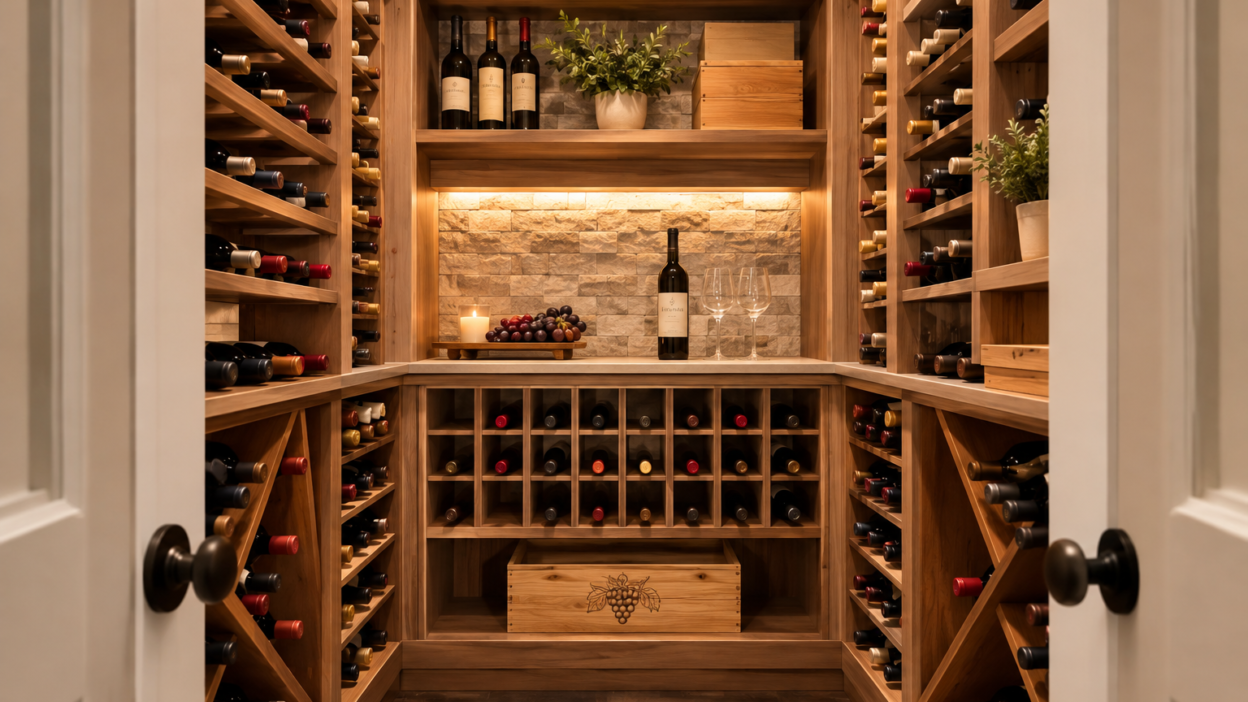
Remember that pantry you once thought would be useful, only to fill it with an air fryer, forgotten cereal boxes, and kitchen gadgets TikTok ads convinced you to buy? If you’re a wine lover, there may be a better use for it.
You could turn that small pantry into your own wine cellar!
Yes, you don’t need a huge basement or an entire spare room. With thoughtful wine cellar design, even a compact pantry can become a beautiful and functional space for your collection. But before you start ordering racks, there are a few important things to consider.
Can You Really Turn a Small Pantry Into a Wine Cellar?
Yes, you can. However, the room needs to provide the right environment for storing wine.
Wine is sensitive to heat, sunlight, vibration, humidity changes, and temperature fluctuations. A pantry beside your oven or dishwasher may not be the best candidate. Ideally, the space should be away from direct sunlight and major heat sources.
Before converting the room, ask yourself:
- Can the walls, ceiling, and floor be properly insulated?
- Can you install a well-sealed door?
- Is there enough electrical access for a cooling system?
- Is the room away from heat-producing appliances?
- Will you have enough space for your current collection and future bottles?
If the answer is mostly yes, your pantry could have serious potential.
What Does a Pantry Need Before You Store Wine?
Here’s where a simple DIY wine rack project becomes a real cellar conversion.
According to Wine-R’s wine cellar construction guidance, proper insulation, a continuous vapor barrier, an insulated gasketed door, and an appropriately sized cooling system are important parts of a controlled storage environment.
The vapor barrier is particularly important. Since the cellar is cooler than the surrounding home, moisture can move through the walls and potentially cause condensation. Wine-R recommends a continuous, sealed vapor barrier on the warm side of the insulation to help prevent moisture-related problems.
In simple terms: build the room correctly before worrying about how pretty it looks.
How Can You Maximize a Small Space?
This is where home wine cellars can be surprisingly clever in your Cypress or Spring home.
A small room doesn’t automatically mean a small collection. Custom-built racking can make better use of corners, narrow walls, and vertical space than standard furniture.
Your custom cellar design should also consider the types of bottles you own. Champagne bottles, larger formats, and oddly shaped bottles may require different storage than standard wine bottles. Leave enough room to reach your collection comfortably, too. A cellar isn’t very useful if finding your favorite Cabernet requires a game of Jenga.
| Pantry Feature | Why It Matters |
| Insulation | Helps maintain stable conditions |
| Vapor barrier | Helps manage moisture movement |
| Sealed door | Limits unwanted air exchange |
| Cooling system | Maintains suitable storage conditions |
| Custom racking | Makes better use of limited space |
| Appropriate lighting | Improves visibility without excessive heat |
Can You Add a Glass Door?
Absolutely. A custom glass wine cellar can make a small space feel more open while displaying your collection.
But don’t choose glass based on appearance alone. Wine-R notes that sealed, double-pane Low-E glass can help manage heat gain, while larger glass areas can increase the cooling load.
So, if you’re considering a wine cellar glass door, make sure it’s included in the overall insulation and cooling plan.
A modern glass wine cellar can look fantastic in a home, but the glass’ technical performance matters just as much as the design.
To DIY or Not to DIY
You can certainly handle the fun parts yourself, such as choosing the racking style, finishes, and lighting. But insulation, vapor barriers, and cooling calculations are best approached professionally.
That’s where custom wine cellar design can make a difference. A professional can:
- Assess the pantry
- Calculate its cooling requirements
- Plan the racking
- Make sure the door and insulation work together
Wine Cellars of Houston, for example, has been designing wine-storage spaces since 1998. Its founder, Rudy Ardon, combines a background in carpentry and wine collecting with experience in cellar construction. The company works on residential and commercial wine cellars, offering custom racking, cooling systems, glass installations, and cellar restoration.
So yes, your small pantry can become a wine cellar! The secret is to focus on the environment before the decor. Get the insulation, vapor barrier, door, cooling, and layout right, and your forgotten pantry could become one of the most useful and stylish spaces in your home.
FAQs
- Does a small wine cellar need a cooling system?
Yes, if you plan to store wine for extended periods, climate control is important. A dedicated wine cellar cooling unit helps maintain consistent temperature and humidity. The system should be sized according to the room, insulation, and heat load rather than simply choosing a standard air conditioner.
- Can I add a glass door to a small wine cellar?
Yes. A properly designed glass door can make a compact cellar feel larger while showcasing your collection. However, ordinary glass may increase heat gain. Choose insulated, energy-efficient glazing and include the door when planning the cellar’s insulation and cooling requirements.
- How much does it cost to convert a pantry into a wine cellar?
There is no single price because the cost depends on the pantry’s size, existing insulation, cooling requirements, door, flooring, racks, and finishes. A professional assessment by a wine cellar construction company, like Wine Cellars of Houston, can identify what the space already has and what needs upgrading, helping you plan a realistic wine cellar budget.