
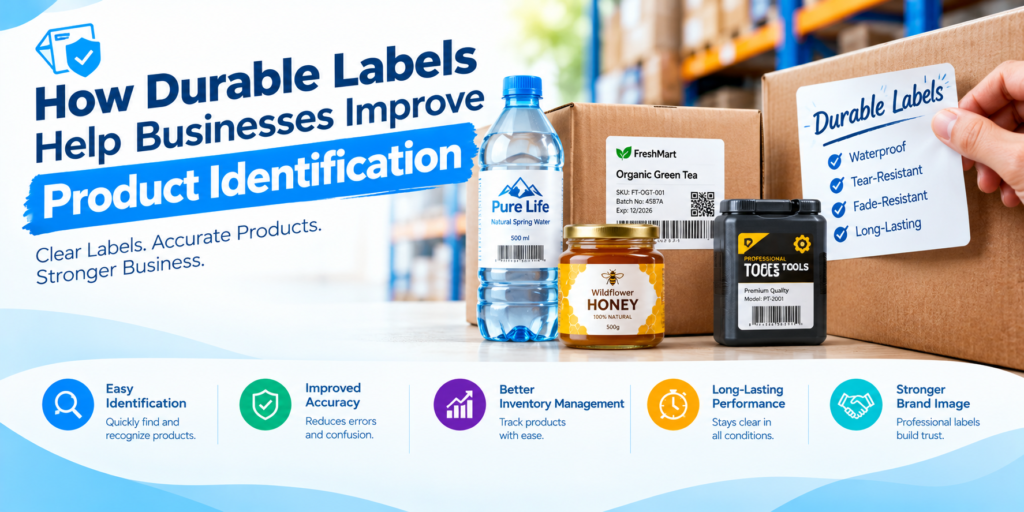
Product labels play an important role in retail, manufacturing, shipping, and inventory management. They display essential information, support product tracking, and help businesses maintain organized operations. Choosing the right printing method can make labels easier to read and more reliable throughout storage, handling, and transportation.
Understanding Thermal Transfer Printing
Custom thermal transfer printing label uses heat to transfer ink from a ribbon onto a label surface. This process creates clear text, numbers, and barcodes that can remain readable for extended periods when the appropriate materials and ribbons are selected.
Unlike direct thermal printing, which uses heat-sensitive label material without a ribbon, thermal transfer printing offers a wider selection of materials for applications requiring additional resistance to smudging, abrasion, and environmental exposure.
Businesses can choose from paper and synthetic label materials depending on their products, storage conditions, and expected label lifespan.
Benefits of Durable Product Labels
Labels need to remain readable throughout a product’s journey, from production and storage to delivery and sale. Poor-quality printing can create problems when information fades or barcodes become difficult to scan.
Durable labels offer several practical advantages:
- Long-lasting readability: Suitable materials and ribbons help preserve printed information over time.
- Improved product tracking: Clear barcodes and identification numbers support inventory management.
- Professional presentation: Consistent, readable labels contribute to a more organized product appearance.
- Reduced reprinting: Reliable labels can help minimize the need to replace damaged or unreadable markings.
The actual performance depends on the label material, adhesive, ribbon type, printing settings, and conditions in which the label is used.
Choosing the Right Label Material
Selecting the right material is essential for achieving dependable printing results. Different businesses have different labeling requirements, so the material should match the intended application.
Paper Labels
Paper labels are a practical option for everyday indoor applications. They are commonly used for shipping information, retail pricing, inventory identification, and warehouse organization. They can be an economical choice when exposure to moisture, chemicals, and heavy abrasion is limited.
Polypropylene Labels
Polypropylene labels offer flexibility and better resistance to moisture than many standard paper options. They can be useful for product identification on suitable packaging surfaces, including applications where labels may encounter occasional splashes or handling.
Polyester Labels
Polyester labels are often selected for applications requiring greater resistance to abrasion, heat, or demanding environmental conditions. They can support equipment identification, asset tracking, and industrial labeling when paired with compatible adhesives and ribbons.
Before choosing a material, businesses should consider the surface, temperature range, exposure conditions, and required service life.
Applications Across Different Industries
Thermal transfer printing is useful across a wide range of industries because businesses often need labels that remain readable during repeated handling.
In warehouses, labels can identify storage locations, cartons, and inventory items. Shipping departments use printed labels to organize parcels and display tracking information. Retailers may use them for pricing, stock control, and product identification.
Manufacturers can also apply labels to components, equipment, and finished goods. In healthcare and laboratory environments, specialized labels may be required to identify samples or supplies. These applications require materials that meet the relevant operational and regulatory requirements.
Thermal Transfer Labels for Barcodes
Barcodes allow businesses to identify products and retrieve information quickly through scanning systems. For a barcode to work properly, its lines and spaces must print clearly and remain readable during use.
Thermal transfer printing can produce sharp barcode images when the printer, ribbon, label stock, and settings are correctly matched. Businesses should test labels with their actual scanning equipment before using them in large quantities.
Barcode dimensions, contrast, placement, and surface quality can all affect scanning performance. A suitable label design helps reduce avoidable scanning issues and supports smoother inventory workflows.
Comparing Thermal Transfer and Direct Thermal Labels
Both printing methods have useful applications, but they are designed for different requirements.
Direct thermal labels do not require a ribbon and are often used for short-term applications such as receipts and shipping labels. However, their print can be more sensitive to heat, sunlight, and environmental conditions.
Thermal transfer labels use a ribbon and are often preferred when longer-lasting print or a broader choice of label materials is needed. The best option depends on how long the label must remain readable and the conditions it will experience.
Custom Label Solutions for Business Needs
Businesses may need labels in particular sizes, shapes, materials, or roll formats to fit their custom label pouches products and printing equipment. Customization can help ensure that important information is positioned clearly while maintaining a consistent appearance across product lines.
Label Pouches offers thermal transfer labeling solutions for businesses looking for durable printed identification. Companies can evaluate material choices, dimensions, and printing requirements to find an option that suits their workflow.
Before placing a large order, it is helpful to confirm printer compatibility, adhesive performance, ribbon requirements, and the expected environment. Testing a sample can help identify potential issues before full production begins.
Conclusion
Reliable labels help businesses maintain clear product identification, organized inventory, and efficient shipping processes. By selecting suitable materials and printing methods, companies can improve barcode readability and reduce problems caused by fading or damaged information. Thermal transfer printing is a useful option for many applications that require durable, professional labeling. Evaluating the product environment, printer compatibility, and expected label lifespan can help businesses choose the right solution for their needs.