
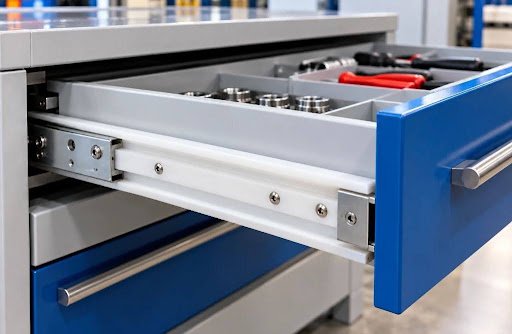
Smooth and reliable movement is important in many industrial and commercial applications. Whether a drawer is used for storing tools, components, equipment, or materials, the sliding mechanism needs to work consistently without excessive force or frequent maintenance. Poor-quality slides can create friction, noise, uneven movement, and premature wear.
This is why material selection plays an important role in drawer slide performance. Teflon, also known as PTFE (polytetrafluoroethylene), is widely recognized for its low-friction properties and resistance to chemicals, moisture, and temperature. When used in suitable drawer slide applications, Teflon drawer slides can provide smooth movement while reducing the need for regular maintenance.
What Makes Teflon Suitable for Drawer Slides?
Teflon is a high-performance fluoropolymer known for its exceptionally low coefficient of friction. In simple terms, surfaces made with or incorporating PTFE can move against one another with less resistance.
For drawer systems, this property can be particularly useful. Every time a drawer opens or closes, the sliding surfaces experience movement and contact. If there is too much friction, the user has to apply more force, and the surfaces may gradually wear.
A properly designed Teflon-based sliding system can minimize this resistance and help maintain smooth operation over repeated cycles.
1. Reduced Friction for Smoother Movement
The primary benefit of Teflon in sliding applications is friction reduction.
Traditional sliding mechanisms may rely heavily on lubricants, bearings, or metal-to-metal contact. While these approaches can work effectively, they may require periodic maintenance depending on the operating environment.
Teflon has naturally low-friction characteristics. This means it can help surfaces move smoothly without relying entirely on conventional lubrication.
In applications where drawers are opened and closed frequently, reducing friction can make everyday operation easier. It can also reduce the mechanical stress placed on connected components.
For manufacturers and equipment designers, Teflon drawer slides can therefore be considered when smooth and dependable movement is an important requirement.
2. Less Wear on Sliding Components
Friction and wear are closely connected. When two surfaces repeatedly move against one another, friction can gradually remove material from the contact surfaces.
Excessive wear can lead to several problems, including increased clearance, uneven movement, noise, and eventual component replacement.
Using a low-friction material such as PTFE can help reduce the amount of resistance generated during movement. However, actual wear performance depends on factors such as load, speed, temperature, mating materials, surface finish, and slide design.
When these factors are properly considered, Teflon-based components can contribute to a longer-lasting sliding system.
3. Reduced Need for Lubrication
One of the practical advantages of PTFE is its ability to provide low-friction performance without depending entirely on conventional liquid or grease lubrication.
This can be valuable in environments where regular lubrication is inconvenient. For example, industrial equipment may be difficult to access after installation. If a drawer slide requires frequent lubrication, maintenance personnel may need to interrupt operations to service it.
A suitable Teflon drawer slides design can reduce reliance on routine lubrication, potentially making the maintenance schedule simpler.
It is important to note that not every PTFE slide application is completely maintenance-free. Specific operating conditions may still require inspection, cleaning, or lubrication depending on the complete system design.
4. Better Performance in Challenging Environments
Industrial drawers are not always used in clean indoor environments. Some are exposed to dust, moisture, chemicals, temperature changes, or other demanding conditions.
Teflon is known for its chemical resistance and low moisture absorption. These characteristics make PTFE useful in applications where conventional materials may face environmental challenges.
For example, components used around certain chemicals or cleaning processes may benefit from materials that are less susceptible to chemical attack.
However, material compatibility should always be evaluated for the specific chemicals and operating conditions involved. A material that performs well in one environment may not be suitable for every application.
5. Reliable Performance Across Repeated Cycles
Drawer slides can experience thousands of opening and closing cycles throughout their service life. Repeated movement places continuous demands on the sliding surfaces.
A well-designed low-friction system can help maintain consistent movement over repeated use.
This is especially important in industrial cabinets, machinery, storage systems, laboratory equipment, and specialized enclosures where drawers may be accessed many times each day.
The goal is not simply to make the first few cycles feel smooth. A good slide system should be designed around the expected load, operating frequency, environmental conditions, and service life.
6. Lower Maintenance Requirements
Maintenance costs include more than the price of replacement parts. Businesses also need to consider labor, equipment downtime, inspection time, cleaning, lubrication, and production interruptions.
When sliding components require less frequent servicing, maintenance teams can spend less time addressing routine mechanical issues.
For facilities with large numbers of storage cabinets or industrial drawers, even small maintenance improvements can become significant over time.
This is one reason Teflon drawer slides may be considered for applications where reducing routine maintenance is an important design objective.
7. Quiet and Controlled Operation
Noise is another factor that can influence the choice of sliding materials.
Metal-to-metal contact, worn bearings, damaged surfaces, or insufficient lubrication can create unwanted noise during drawer movement. Depending on the application, this may be more than a minor inconvenience.
A properly engineered PTFE sliding interface can provide smooth contact and help reduce harsh friction-related sounds.
This can be useful in environments such as laboratories, workshops, commercial facilities, and specialized equipment areas where controlled and quieter operation is desirable.
8. Suitable for Custom Applications
Not every drawer system has the same dimensions or operating requirements. Some applications require customized components because standard slides may not fit the available space or load requirements.
PTFE can be machined or incorporated into different component designs depending on the application. This gives manufacturers flexibility when developing custom sliding solutions.
A custom component may be designed around specific dimensions, load requirements, mounting arrangements, and movement patterns.
Before selecting Teflon drawer slides, engineers should consider the complete system rather than focusing only on the material. The slide geometry, supporting structure, load distribution, mating surface, and installation method can all affect performance.
Factors to Consider Before Choosing Teflon Slides
Although Teflon offers several useful properties, selecting the right slide requires more than simply choosing PTFE.
The following factors should be evaluated:
- Load capacity: Determine the maximum weight the drawer will carry.
- Operating temperature: Check the expected temperature range during normal operation.
- Movement frequency: Consider how often the drawer will be opened and closed.
- Speed: Sliding speed can influence friction and wear.
- Mating material: The surface moving against PTFE can significantly affect performance.
- Environment: Consider moisture, dust, chemicals, and other contaminants.
- Dimensions: Ensure the slide design fits the available space and mounting arrangement.
- Expected service life: Estimate the number of operating cycles required.
These considerations can help prevent premature wear and ensure the sliding system performs as intended.
Teflon vs. Conventional Drawer Slide Materials
Traditional drawer slides can be manufactured using metals, plastics, rollers, bearings, or combinations of different materials. Each approach has its own advantages.
Metal slides, for example, can provide high structural strength and may be appropriate for heavy-duty applications. Ball-bearing systems can offer smooth movement and substantial load capacity when properly designed.
Teflon-based sliding components are particularly attractive when low friction, chemical resistance, low moisture absorption, and reduced dependence on conventional lubrication are important.
The right choice ultimately depends on the application’s requirements. PTFE should not automatically replace every other slide material; instead, it should be evaluated based on the operating conditions and performance objectives.
Why Proper Design Matters
Even a high-performance material can underperform if the overall slide system is poorly designed.
Incorrect clearances, excessive loads, misalignment, rough mating surfaces, or improper installation can increase friction and accelerate wear. Material selection should therefore be combined with proper engineering and installation practices.
Manufacturers should ideally test the finished slide under conditions that resemble its real operating environment. Testing can reveal issues that may not be obvious during initial design.
This approach helps ensure that the final product provides the expected combination of smooth movement, durability, and maintenance efficiency.
Final Thoughts
Reducing friction is one of the simplest ways to improve the operation and longevity of a sliding mechanism. Teflon’s low-friction characteristics, chemical resistance, and ability to perform in a range of demanding environments make it a useful material for certain drawer slide applications.
When correctly designed and matched to the operating conditions, Teflon drawer slides can help provide smoother movement, reduce component wear, minimize lubrication requirements, and simplify routine maintenance.
However, successful performance depends on more than material selection. Load, temperature, speed, environment, mating surfaces, dimensions, and installation all need to be considered. By evaluating these factors carefully, manufacturers can develop drawer systems that provide reliable performance and practical long-term value.