
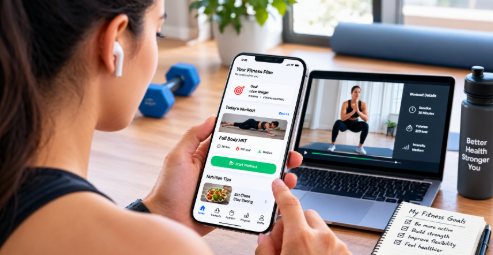
A secondary school PE teacher I know moonlights as a personal trainer on weekends. She has twelve weekend clients. She could have more people ask regularly but twelve is the number she can actually serve well. The limitation isn’t her expertise. It isn’t her availability, within reason. It’s the fundamental constraint that personal training is a relationship delivered one person at a time, and one person has a finite number of hours in a weekend.
The people on her waiting list aren’t being turned away because personalized fitness guidance doesn’t exist for them. They’re being turned away because the delivery mechanism that has historically carried personalized fitness guidance a human coach working one-on-one doesn’t scale.
Mobile apps are changing this in ways that aren’t a perfect substitute for what she provides in person and represent a genuine improvement over the generic fitness content that was the only alternative before. The improvement is in personalization the ability to deliver guidance that reflects who a specific person is, what they’re working toward, what their body has done before, and how it’s responding now at a scale that individual coaches never could. A thoughtful Fitness App Development company building in this space is building the infrastructure that extends something that used to be scarce into something far more widely accessible. Here’s how that extension is actually happening.
What Personalization in Fitness Actually Means
Before getting into how apps are delivering it, it’s worth being specific about what personalization in fitness actually involves, because the word gets used loosely enough to cover very different things.
At its most basic, personalization means programming that reflects individual goals. Someone who wants to lose weight needs a different program from someone who wants to run their first marathon, who needs a different program from someone recovering from a knee injury, who needs a different program from an experienced lifter trying to add muscle mass. This level of personalization is achievable through questionnaires and branching program logic and has been available in fitness apps for years. It’s personalization in the sense that the program is tailored, but it’s personalization at the population segment level the program for “beginner wanting to lose weight” rather than a program for this specific person.
Deeper personalization accounts for individual variation within those broad categories. Two beginners wanting to lose weight may have very different starting fitness levels, different injury histories, different equipment availability, different amounts of time per session, different preferences for exercise types, and different rates of progress. A program that serves one well may be too challenging or too easy or simply wrong for the other, even though they’d be assigned to the same population segment by a simple questionnaire.
The deepest level of personalization what an experienced coach provides accounts for how a specific individual is actually responding to training over time. Is this person recovering adequately between sessions or showing signs of accumulating fatigue? Are they making expected progress on key lifts or stalling in ways that suggest the program needs adjustment? Are they consistently skipping certain exercises in ways that suggest those exercises don’t work for their body or their schedule? This real-time, longitudinal, behavior-responsive personalization is what separates a good coach from a good program, and it’s what apps have been working toward with increasing sophistication.
How Apps Are Delivering Each Layer of Personalization
The first layer population segment personalization is table stakes for any serious fitness app. The interesting question is how apps are moving up the personalization stack toward the deeper, more responsive forms.
Behavioral data from app usage is the primary input for moving beyond population segment personalization. An app that can see that a user consistently completes the first three exercises in a session and never completes the fourth one is accumulating information that a coach would have and that a population-segment program doesn’t have. An app that can see that a user’s session frequency drops off when session length exceeds forty minutes has information that should adjust future programming. An app that can see that a user consistently logs lower performance ratings on Monday morning workouts has signal about recovery patterns that would inform a knowledgeable coach’s programming.
The apps that have built genuine behavioral personalization are using this accumulated behavioral signal to make decisions that generic programs don’t make adjusting session length automatically when completion data suggests the planned length isn’t working, adjusting exercise selection based on logged preferences and avoidances, adjusting progression rates based on actual performance against planned targets rather than following a fixed progression regardless of how the athlete is responding.
Wearable integration has added a physiological dimension to behavioral personalization that represents a qualitative step up in what apps can know about individual users. Resting heart rate trends that indicate accumulating fatigue. Heart rate variability scores that suggest whether a high-intensity session or a recovery session is appropriate. Sleep quality the night before a planned hard session. Activity level on non-training days. These physiological signals are the data that sports scientists use to manage elite athletes’ training loads, and they’re now available through consumer wearables to anyone willing to pay attention to them.
The apps using wearable data to adjust training recommendations reducing planned session intensity when HRV suggests inadequate recovery, recommending additional rest when accumulated training load metrics suggest it’s warranted, adjusting weekly volume when sleep quality has been consistently poor are providing a level of load management that recreational athletes have never had access to at this price point. A recreational runner following a personalized training plan that adjusts based on their physiological readiness is training in a way that the runner’s-world-article-based plans of a generation ago never allowed.
The Population That Personalization Has Historically Excluded
Personalized fitness guidance has historically been a premium service expensive enough that the people who most benefit from personalized guidance often can’t afford it, and distributed through gyms and training facilities that require geographic proximity and a willingness to enter spaces that many people find intimidating.
The people who’ve been most consistently underserved by the traditional personal training model are people who are newer to fitness and most uncertain about what they’re doing, who would benefit most from knowledgeable guidance but are also least likely to have the confidence to seek it in a gym environment. The person who’s significantly overweight, who’s never exercised as an adult, who feels conspicuous in a gym and uncertain about every piece of equipment this person could benefit enormously from a knowledgeable coach guiding them through the early stages of building a fitness practice, and they’re the person least likely to walk into a gym and hire one.
Apps have reached this population in ways that traditional fitness has not, primarily by removing the barriers that aren’t about fitness itself. No commute to a facility. No environment that feels like it wasn’t designed for you. No performance in front of strangers. No need to project confidence about what you’re doing before you have any reason to feel confident. The beginner who follows their first workout in their living room, who progresses through a structured program at their own pace without anyone watching, and who builds enough confidence and capability over months to feel ready to engage with a gym environment if they choose to this person’s fitness journey started where traditional fitness couldn’t reach them.
Personalization for Specific Populations That Generic Programming Ignores
Beyond the general underserved population, personalization through apps has begun to serve specific populations that generic fitness programming has historically addressed poorly or not at all.
Older adults represent the most significant gap in fitness technology coverage relative to population size and need. Strength and mobility work for people over sixty has specific requirements appropriate load management, emphasis on movement quality over intensity, attention to balance and proprioception, exercise selection that avoids positions or movements contraindicated by common age-related conditions that generic fitness programming doesn’t account for. Apps built specifically for older adult fitness, with exercises selected and modified for this population, with progression models appropriate for its physiology, and with form guidance that addresses the specific challenges this demographic faces, are reaching a population that the gym-and-trainer model serves inadequately.
Prenatal and postnatal fitness represents another population where specialized personalization produces dramatically different outcomes from generic programming. The physiological changes of pregnancy and the recovery requirements of the postnatal period are specific enough, and the consequences of inappropriate exercise specific enough, that generic programming is actively inappropriate rather than merely suboptimal. Apps built around these specific physiological realities, with clinical input from appropriate specialists, serve a population for which the traditional fitness industry’s offerings have historically ranged from inadequate to dangerous.
People returning to fitness after significant absence due to injury, illness, pregnancy, or simply years of sedentary life need programming that starts from genuine deconditioning without treating them as though they have no fitness history. The person who was an active athlete in their twenties and is returning to fitness in their forties needs different programming from a true beginner and different programming from someone who’s been continuously active. Apps that can accommodate this specific return-to-fitness experience produce better outcomes and better retention than those applying a binary active/beginner classification.
The Social Dimension of Accessible Personalization
Personalization and social motivation have historically been treated as separate features in fitness apps the personalized program on one hand and the community and challenge features on the other. The apps that have thought through how these interact are producing something more than the sum of either.
A fitness challenge that’s calibrated to individuals at different fitness levels so that a beginner and an experienced athlete are working toward scaled versions of the same goal rather than the experienced athlete dominating every leaderboard produces social motivation without the discouragement that unscaled competitive features produce for the people who most need the motivation.
Shared progress toward personalized goals the app that lets users share not just what they did but whether they hit their personalized target for that session creates accountability to a goal that’s actually relevant to the individual rather than accountability to a standard that may or may not fit their situation. The runner who shares that they hit their target heart rate for their zone two training run is sharing a personalized achievement that makes sense in their context, which is more meaningful than sharing a generic time or distance that doesn’t reflect what they were trying to accomplish.
What Building Personalization Actually Costs
For founders evaluating what level of personalization to build toward, Fitness App Development Cost for genuinely personalized experiences scales considerably with the depth of personalization being attempted.
A population-segment personalized app questionnaire-based program assignment with fixed progressions can be built for $40,000 to $80,000 at MVP. Behavioral personalization that adapts based on completion data and logged performance adds meaningful complexity to the recommendation logic and typically runs $100,000 to $200,000 for a well-built implementation. Full physiological personalization with wearable integration, HRV-based training recommendations, and adaptive load management runs $200,000 to $400,000 depending on the breadth of wearable integrations and the sophistication of the adaptation logic.
These costs reflect real engineering complexity the recommendation system that adapts based on behavioral data requires a data model, a feedback loop, and recommendation logic that is genuinely more complex than the program assignment logic of population-segment personalization. The investment is justified when the personalization depth is the core value proposition, which for most fitness apps targeting populations who need personalized guidance rather than motivated self-directed athletes, it should be.
The PE Teacher’s Waiting List
She still has a waiting list. She probably always will the in-person relationship she provides has qualities that apps don’t replicate, and people who want those qualities will continue to seek them from coaches who can provide them.
What’s changed is what the people on her waiting list do while they wait, and what some of them find when they use a well-built fitness app. Some discover they can get further than they expected without in-person coaching. Some build enough fitness and confidence through an app that when they do eventually work with her, they’re better prepared to use the coaching relationship productively. A few have discovered that what they actually needed was accessible personalized guidance rather than specifically in-person guidance, and that an app serves their actual need well enough that the waiting list doesn’t matter.
The personalized fitness guidance that she provides to twelve people in a weekend is becoming available to considerably more people than that. Not at her level. Not for everyone. But for the populations that traditional fitness has consistently failed to reach, accessible personalization through mobile apps is genuinely better than what was available to them before, and that gap is closing further every year.