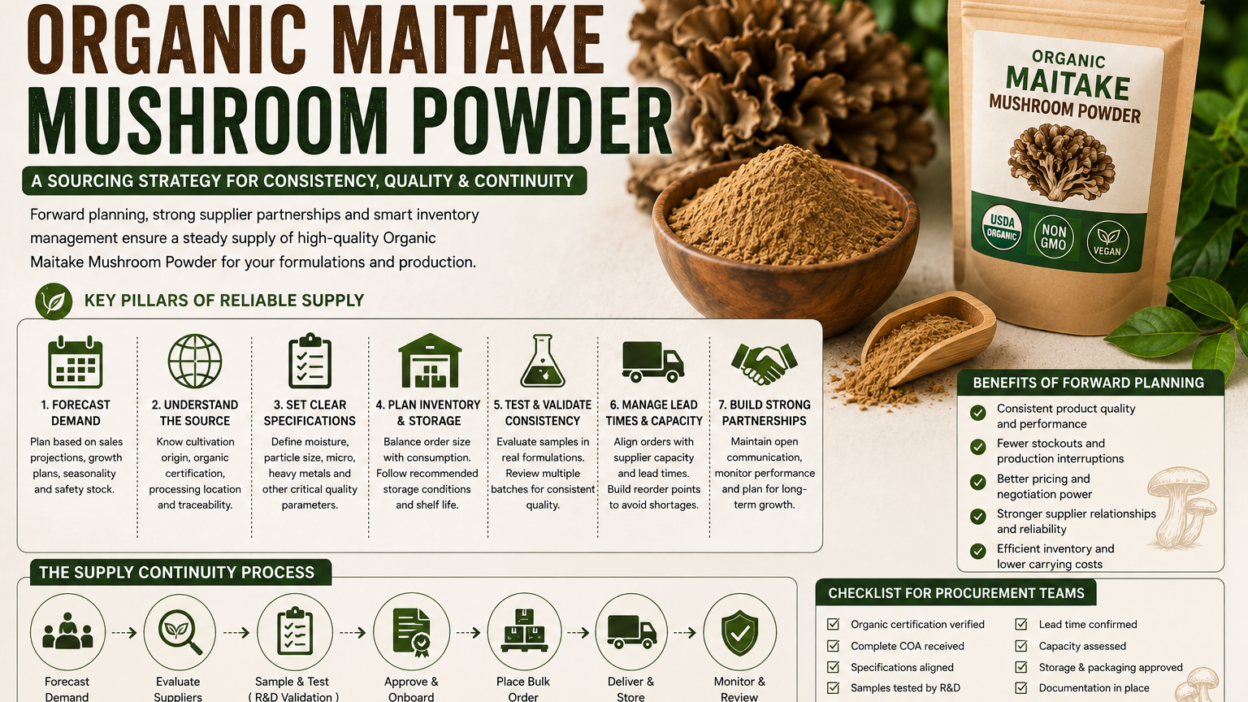
For manufacturers using functional mushroom ingredients, sourcing decisions need to account for more than today’s purchase order. Procurement teams must consider future demand, supplier capacity, inventory, quality consistency, and delivery schedules to keep production running without interruptions.
When sourcing Organic Maitake mushroom Powder, a forward-looking procurement strategy can help manufacturers manage these challenges. For companies purchasing Bulk Maitake mushroom Powder, combining demand forecasting with supplier qualification and inventory planning can create a more dependable supply program.
Why Forward Planning Matters
Ingredient demand can change quickly as a product moves from development to commercial production. A small R&D requirement may become a recurring bulk order once a product gains market traction.
If procurement waits until inventory is nearly depleted before contacting a supplier, there may be limited time to resolve delays, production constraints, or documentation issues.
Forward planning gives buyers more flexibility to evaluate suppliers, compare lead times, and establish appropriate inventory levels.
Begin With a Realistic Demand Forecast
Procurement teams should work with production, sales, and supply-chain teams to estimate future Maitake powder requirements.
The forecast can consider:
- Current production volume
- Planned product launches
- Expected sales growth
- Seasonal demand
- Minimum production quantities
- Lead times
- Safety-stock requirements
Forecasting does not need to be exact. Its purpose is to give suppliers enough visibility to prepare capacity and help buyers plan purchase cycles.
For manufacturers expecting rapid growth, suppliers should also be asked whether they can support higher volumes later.
Understand the Supply Chain Behind the Ingredient
Maitake, commonly known as Grifola frondosa, is cultivated and processed before becoming a finished powder.
For organic sourcing, buyers should understand the cultivation or raw-material source, country of origin, processing location, and certification status.
Procurement teams can ask suppliers about:
- Raw-material traceability
- Organic certification
- Processing locations
- Batch identification
- Quality-control procedures
- Backup sourcing arrangements
Supply-chain visibility can help manufacturers identify potential risks before they affect production.
Establish a Consistent Quality Specification
Inventory planning is useful only when the material entering the warehouse meets the required specification.
Before establishing recurring purchasing agreements, R&D and quality teams should define the characteristics required for Organic Maitake mushroom Powder.
These may include moisture, particle size, appearance, microbiological limits, heavy metals, pesticide residues, and other application-specific parameters.
The specification should remain consistent across supplier evaluations so that procurement can compare quotations on an equivalent basis.
Consider the Impact of Storage
Bulk purchasing can provide commercial advantages, but larger inventory also creates additional storage requirements.
Warehouse teams should understand the supplier’s recommended storage conditions, packaging format, shelf life, and handling requirements.
Packaging should protect the powder during transportation and storage while also fitting the manufacturer’s existing warehouse and production systems.
Procurement should balance order size against actual consumption to avoid holding excessive inventory for extended periods.
Keep R&D Involved in Supplier Changes
Supply continuity should not come at the expense of formulation consistency.
If a manufacturer needs to change suppliers or approve an alternative source, R&D should evaluate the replacement material before commercial use.
Even when two suppliers provide products with similar specifications, physical or sensory differences may affect the finished formulation.
Sample testing can examine:
- Appearance
- Aroma
- Taste
- Flowability
- Particle distribution
- Blend uniformity
- Dispersion
- Moisture behavior
This creates a controlled process for managing supplier changes.
Build a Multi-Batch Quality History
Supplier performance becomes easier to evaluate when buyers collect information over time.
Quality teams can compare COAs from several production lots and track important parameters. Procurement can combine this information with delivery records and communication history.
A supplier that consistently meets specifications and delivery commitments creates a stronger basis for long-term sourcing than one with only a successful initial shipment.
Plan Bulk Orders Around Lead Times
When purchasing Bulk Maitake mushroom Powder, procurement teams should understand standard and extended lead times.
Buyers can establish reorder points based on average consumption, supplier lead time, safety stock, and production schedules.
This reduces the likelihood of emergency purchasing and gives procurement more time to address unexpected supplier constraints.
Where appropriate, companies may also consider qualifying a secondary supplier to provide additional supply flexibility.
Evaluate Supplier Capacity Before Demand Peaks
A supplier’s current capacity may not reflect future availability.
Procurement teams should ask whether production can scale with the manufacturer’s forecast and whether additional lead time is required for larger orders.
Questions about minimum order quantities, production schedules, packaging, inventory, and capacity allocation can help buyers determine whether a supplier is suitable for long-term commercial supply.
Monitor Performance Continuously
Supply planning should continue after supplier approval.
Procurement can track on-time delivery, lead-time accuracy, pricing, order fulfillment, and communication. Quality can monitor batch compliance and documentation, while R&D can record formulation performance.
These metrics provide an ongoing view of supplier reliability.
Conclusion
Reliable sourcing of Organic Maitake mushroom Powder requires planning beyond the next purchase order. Manufacturers purchasing Bulk Maitake mushroom Powder need to connect demand forecasting, supplier capacity, quality control, storage, formulation testing, and inventory management.
By forecasting demand early, maintaining clear specifications, reviewing supplier capacity, monitoring batch consistency, and planning appropriate inventory levels, procurement teams can reduce supply interruptions and improve purchasing efficiency.
For manufacturers building long-term functional ingredient programs, proactive sourcing provides an important advantage: greater confidence that the right ingredient will be available when production needs it.