
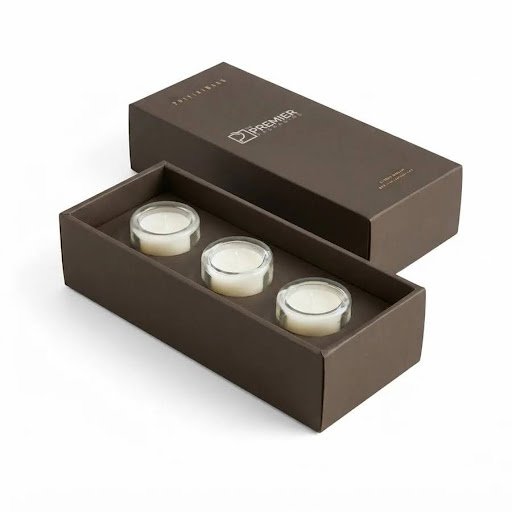
Nobody expects a tealight to be the fragile item in a shipment. It’s small, it’s simple, there’s nothing sharp or obviously breakable about it. That assumption is exactly why so many tealights arrive scratched, dented, or cracked. Wax is a lot softer than people give it credit for, and once a tealight picks up a mark, there’s no fixing it – it just looks used before it’s ever been lit. Good box construction isn’t about making something elaborate. It’s about actually understanding the specific, small ways these candles get damaged in transit and designing around that instead of assuming small equals sturdy.
What Actually Damages a Tealight in Transit
Wax is soft, particularly around the wick and along the candle’s outer edges. Even moderate pressure leaves a dent. A bit of friction leaves a scratch. And because tealights are almost always shipped in groups rather than one at a time, most of the damage doesn’t come from one dramatic event – it comes from dozens of small ones stacking up over the course of a shipping journey.
The most common culprits:
- Candles rubbing against each other repeatedly during movement, which leaves fine surface scratches
- Compression from stacked weight, which cracks or chips the edges
- Direct contact with a hard, uncushioned box wall, which leaves dents in the wax
- A wick that shifts or bends because the candle wasn’t held firmly in one position
Separation Solves Most of the Problem
If there’s one design choice that matters more than anything else here, it’s keeping each tealight in its own compartment rather than letting a batch of them roll around loose in a shared space. Loose candles bump into each other constantly during shipping, and that repeated contact is responsible for the bulk of the scratching that shows up by the time a shipment reaches its destination.
Die-cut dividers, molded trays, or individually fitted inserts all solve this the same basic way – by isolating each candle so it physically can’t touch its neighbors. Once that contact is eliminated, scratching and chipping drop off dramatically.
Cushioning Has to Be Precise, Not Just Present
It’s tempting to assume more padding automatically means more protection, but that’s not quite true for tealights specifically. A thin liner or a molded tray with a bit of give usually protects better than a box stuffed with loose padding, because loose material can shift during transit and create uneven pressure points on the wax. A well-fitted compartment with minimal, targeted cushioning tends to outperform a heavily padded box that wasn’t designed with the product’s exact shape in mind.
Temperature Is Part of the damage equation, too
Something that gets overlooked constantly: wax reacts to heat. A tealight that’s warmed slightly during a hot shipping leg becomes noticeably softer and more vulnerable to pressure damage than it would be at a stable room temperature. That combination of warm wax and stacked weight is a common reason candles show up dented or misshapen even when nothing obviously went wrong during handling.
Packaging can’t control shipping temperatures, but a rigid outer box that resists compression limits how much of that softened-wax vulnerability actually translates into visible damage. It’s a small buffer, but it matters.
Presentation and Protection Aren’t Mutually Exclusive
Protection comes first, but tealight packaging also serves a marketing function, especially for scent-driven or seasonal product lines. A pecan waffle tealight box, for instance, benefits from packaging that visually hints at the scent – warm colors, cozy imagery, something that evokes the actual profile of the candle – while still handling the structural job of keeping each piece scratch-free.
The mistake to avoid is letting decorative printing take priority over compartment design. A box can look great on a shelf and still perform badly once it’s actually shipped if the interior structure wasn’t given equal attention.
Sizing Compartments to the Actual Product
Tealights vary in diameter and height depending on the brand or supplier, and a compartment built for one size won’t necessarily fit another cleanly. Get the sizing slightly too loose, and the candle has room to shift. Too tight, and forcing it into place risks cracking the wax before it’s even shipped.
Brands producing their own tealights in-house have an easier time here, since they can design packaging around their exact product dimensions rather than trying to match a generic size that might not align perfectly with what they’re actually making.
A Quick Checklist for Getting This Right
- Confirm the compartment size matches the actual tealight dimensions, not an industry-standard estimate
- Choose individual compartments over shared open trays whenever volume allows for it
- Keep cushioning thin and targeted rather than loose and excessive
- Use a rigid outer box to reduce the impact of temperature-related softening
- Balance decorative printing with genuine structural protection, rather than prioritizing one over the other
Final Words
Tealights don’t look like a packaging problem until you’ve shipped a few thousand of them and dealt with the returns tied to scratched or dented candles. Compartment separation, precise cushioning, and a sturdy outer box handle most of the risk, and none of it requires overengineering the packaging. It just requires treating a small, unassuming product with the same care as anything else that needs to survive real handling and arrive looking the way it did the day it left production.